November 12, 2026 | Allegheny-Blue Ridge Alliance
Coal mining has resumed at part of the former South Fork Coal complex in Greenbrier County, West Virginia, despite numerous outstanding state enforcement orders that should prohibit coal removal until environmental violations are corrected. Allegheny-Blue Ridge Alliance (ABRA) has filed citizen complaints with the West Virginia Department of Environmental Protection (WVDEP) and requested inspections of the operations.
On October 26, ABRA received a tip that coal trucks were moving along Haulroad #1, part of the 3,600-acre mining complex now controlled by Clearco Processing and Aurevo Resources. We reviewed the available permit and enforcement records and contacted WVDEP. In a subsequent conversation with ABRA staff attorney Andrew Young, a WVDEP inspector confirmed that coal was being mined at the Laurel Creek Contour Mine and transported along Haulroad #1 to the Clearco preparation and loadout plant.
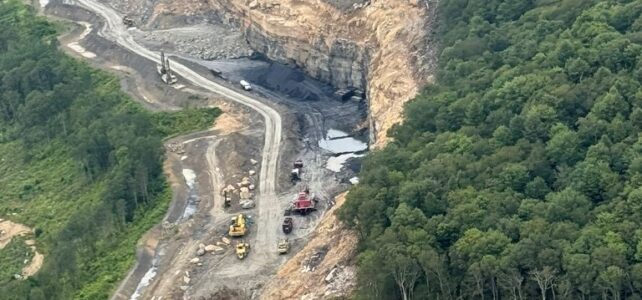
According to the inspector, WVDEP was allowing the operations to proceed under advance approval granted to the new operators, even though South Fork Coal, which entered bankruptcy in 2025, remained the named permit holder.
That explanation raises serious questions. When a mining company fails to correct certain environmental violations, regulators issue cessation orders requiring operations to stop until those violations are addressed. Advance approval of a permit transfer does not simply erase those orders.
ABRA’s review of publicly available enforcement records identified seven outstanding cessation orders at the Laurel Creek mine, three at Haulroad #1, and six at the Clearco preparation plant. Two of the orders at Laurel Creek stem from violations dating back to spring 2024. Across the ten mining permits controlled by Clearco and Aurevo, our review identified at least 68 cessation orders still in effect as of November 11.
“You don’t get to inherit the right to mine without inheriting the responsibility to comply with the law,” said Young.
ABRA has asked WVDEP to inspect the Laurel Creek mine, Haulroad #1, and the Clearco facility, and to explain how operations are being allowed to continue under these circumstances. As of November 11, the requested citizen inspections had not taken place.
A much larger enforcement problem
This is only the latest development in a dispute ABRA has been following for several years.
Our staff has spent considerable time reviewing mining permits, enforcement records, land ownership information, and the network of haul roads connecting the mines to processing facilities. That research has helped identify conflicts between mining operations, state permits, and federal protections for the Monongahela National Forest.
In September, ABRA worked with conservation partners to submit extensive comments opposing proposed U.S. Forest Service authorizations for coal hauling over national forest roads. We are now preparing objections to a proposed special-use permit that would allow continued use of Haulroad #2, including sections crossing public land.
Meanwhile, on October 29, Appalachian Voices, West Virginia Highlands Conservancy, and Sierra Club filed a federal lawsuit against Aurevo Resources and its officers, alleging more than 50 violations of the Surface Mining Control and Reclamation Act. The groups are represented by Appalachian Mountain Advocates. The lawsuit, built largely on ABRA’s years of research, seeks to compel compliance with reclamation requirements at mines formerly operated by South Fork Coal.
The litigation and ABRA’s citizen complaints are separate actions, but they address the same underlying problem: mining operations being transferred to new companies while extensive environmental violations remain unresolved.
What happens next?
ABRA is continuing to review enforcement records and permit-transfer documents, and we are pressing state and federal regulators to investigate the reported mining and hauling activity.
We also remain involved in the Forest Service permitting process, where proposed coal-hauling authorizations could affect public access, streams, and sensitive habitat within the Monongahela National Forest for years to come.
These questions deserve answers before additional coal is removed and more damage is done. ABRA will continue documenting what is happening, making that information available to the public, and working with conservation and legal partners to hold both mining operators and regulatory agencies accountable.